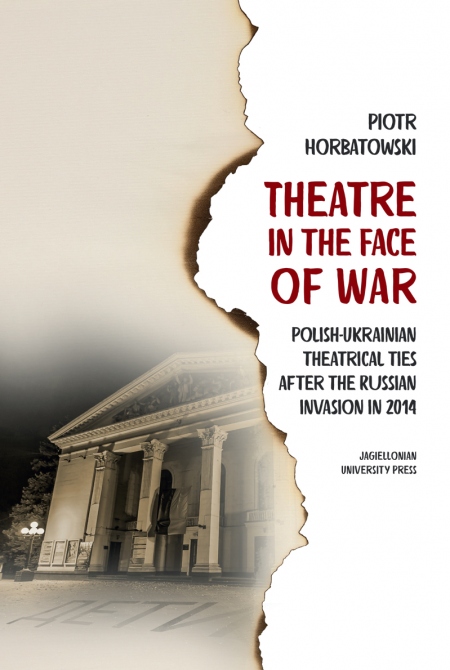
Theatre in the Face of War
Polish-Ukrainian theatrical ties after the Russian invasion in 2014
Przekład: Janina Lloyd
Liczba stron: 196
Format: 15,8x23,5 cm
Rok wydania: 2025
Data premiery: 21.05.2025
Opis książki
This book aims to commemorate and honor people and events in Polish and Ukrainian theater at a time when people-to-people solidarity is especially important and should rise above nationalistic prejudices, historical resentments or political interests. For Polish and Ukrainian theater artists, 2014 and the beginning of the Russian military intervention in Ukraine marked a period when distant poetics and theatrical traditions, as well as artists who had no creative or social ties to each other, began to work together. They began to discover themselves and their theater in the face of an enemy that, for some, was real and a threat, destroying their country, and for others a potential danger.
The ambition of the book is to present artistic activities in a broad social and political context. For theater in the face of war never functions in an abstract vacuum, it happens “here” and “now,” created by people for whom art is both a form of artistic expression, but also a struggle for independence.
The ambition of the book is to present artistic activities in a broad social and political context. For theater in the face of war never functions in an abstract vacuum, it happens “here” and “now,” created by people for whom art is both a form of artistic expression, but also a struggle for independence.
O Autorze
Professor Piotr Horbatowski's scholarly work focuses on the study of the history of the theatrical activity of Poles abroad, with particular emphasis on the East and Far East. He is the author of monographs devoted to Polish theatrical life in Ukraine. In the field of glottodidactics, he is interested in innovative, unconventional teaching methods. He is the author of the method of teaching Polish language through theater, as well as the use of student newspaper editorials to teach Polish language and culture. He has worked abroad as a Visiting Professor at: University of Connecticut, Central Connecticut State University, Indiana University (USA), Tokyo University of Foreign Studies (Japan), Hankuk University of Foreign Studies (South Korea), Guangdong University of Foreign Studies (China). From 2005 to 2009 and 2011 to 2012, he served as director of the School of Polish Language and Culture at the Jagiellonian University. From 2012 to 2016, he was director of the Center for Polish Language and Culture in the World at the Jagiellonian University. Since 2021, he has been the director of the Institute of Polish Studies Glottodidactics at UJ.
Język publikacji
angielski
Wydanie
pierwsze
Autorzy
Piotr Horbatowski

Tłumaczenie
Janina Lloyd
Projekt okładki
Marta Jaszczuk
ISBN: 978-83-233-5474-1
e-ISBN (pdf): 978-83-233-7646-0
Kraj pochodzenia producenta: Polska
POLECANE KSIĄŻKI
75,00
zł
60,00
zł

NOWOŚCI


Męskie, żeńskie w średniowiecznej poezji kobiet w języku oksytańskim
( Oprawa miękka )
56,70
zł
45,36
zł
Niedostępny




Ktistes/Oikistes Mythological and Historical Founders Ofancient Cities and Colonies. Electrum vol. 32
( Oprawa miękka )
48,60
zł
38,88
zł


Psychoonkologia w opiece paliatywnej i u schyłku życia
( Oprawa miękka ze skrzydełkami )
95,00
zł
76,00
zł




Źródła do dziejów wychowania patriotycznego Polaków w XX wieku. Tom 2
( Oprawa twarda )
61,95
zł
49,56
zł

Theatre in the Face of War
Polish-Ukrainian theatrical ties after the Russian invasion in 2014
Theatre in the Face of War
Polish-Ukrainian theatrical ties after the Russian invasion in 2014
Wybierz rozdziały:
Wartość zamówienia:
0.00 zł