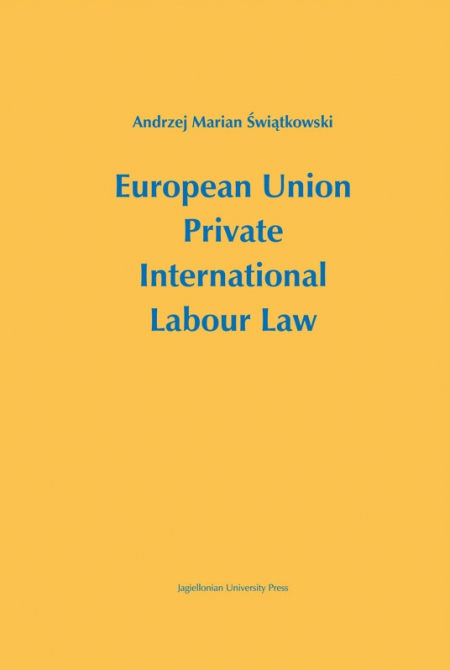
European Union Private International Labour Law
(EU PILL)
Liczba stron: 344
Format: B5
Rok wydania: 2012
Data premiery: 13.02.2012
Data wydania e-booka: 24.09.2024
Opis książki
The European Union as an area of freedom, security and justice has created a community which adheres to unified laws. In matters regulated by labour law (individual and collective) as well as social security law, the above aim may be met by introducing unified regulations, allowing for identical ways of resolving conflicts of labour law that arise in work relations where there is a cross national element present. In order to ensure legal stability within work relations, national regulations concerning international private labour law had to be replaced by unified conflicts of law norms. These norms are to be applied by both employees and employers of EU member states as well as applied in work relations situations where third parties are involved. EU private international law is a collection of international private labour law regulations issued by EU institutions, which unanimously and in a unifying fashion describe the legal situations of the parties to a work relationship, where there is a foreign element present, allowing for the application of foreign laws based on citizenship, residency, where the headquarters of one of the parties is located, where the work is carried out or where the action has taken place. This book is devoted to regulating labour relations and social security conflict issues and contains material on international treaties enforced in the EU (Regulation No. 593/2008 "Rome I," Regulation No. 864/2007 "Rome II," Council Directive No. 38/2009 on the establishment of a European Works Council, Regulation No. 883/2004 on the coordination of social security systems). Such treaties uniformly regulate the resolution of conflicts in individual and collective labour relations and coordinate national social security systems required for clarity purposes. Thanks to such clarity, decisions can easily be made with regard to matters relating to the selection of appropriate systems of substantive and procedural law, and indicate whether labour courts have the jurisdiction to rule in contested cases arising from such legal relations (Brussels, Lugano conventions and the EC Council Regulation No. 44/2001 on the jurisdiction, recognition and enforcement exercising in civil matters).
Język publikacji
Angielski/English
Autorzy
Andrzej Marian Świątkowski
ISBN: 978-83-233-3172-8
e-ISBN (pdf): 978-83-233-8389-5
Kraj pochodzenia producenta: Polska
POLECANE KSIĄŻKI

75,00
zł
60,00
zł

105,00
zł
84,00
zł
NOWOŚCI





Źródła do dziejów wychowania patriotycznego Polaków w XX wieku. Tom 2
( Oprawa twarda )
61,95
zł
49,56
zł

Terapia poznawczo-behawioralna. Wydanie trzecie
( Oprawa miękka ze skrzydełkami )
100,00
zł
80,00
zł




Materiały do nauczania zdrowia publicznego na kierunku pielęgniarstwo metodą PBL (Problem Based Learning)
( Oprawa miękka )
40,95
zł
32,76
zł


Wybierz rozdziały:
Wartość zamówienia:
0.00 zł