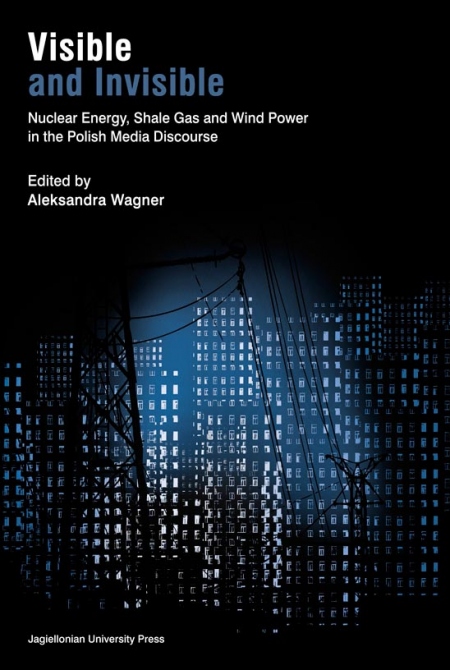
Visible and Invisible
Nuclear Energy, Shale Gas and Wind Power, in the Polish Media Discourse
Redakcja: Aleksandra Wagner
Przekład: Benjamin Koschalka
Liczba stron: 194
Format: B5
Rok wydania: 2017
Data premiery: 18.04.2017
Opis książki
This book came about as the result of research encompassing a period from˛the 1980s (archival research) until 2014. Various media forms and diverse channels of mass communication were analysed in the selected time periods, which allowed us to gather material that on the one hand was abundant and differentiated and on the other illustrated the dynamic of changes based on consistent tracking of the fiields of nuclear and wind policy and shale gas. It was no coincidence that these types of energy were chosen, while the most obvious one in Poland, coal, was left out. When the research began, they were (all in their own way) innovative technologies. Nuclear energy – perhaps the hardest to defiine in this way (as many actors treat it as a technology of the past) – is still to be implemented in Poland. For several years, though, it has again begun to be considered as a solution that might satisfy the future demands of energy policy, assuring a stable energy supply, increasing the country’s energy independence and leading to reduced CO2 emissions. In this sense (as a new solution), it is an innovative approach for the Polish energy system.
Wind energy is the most popular renewable energy source (RES) in Poland, as well as the most recognisable and the one most readily associated with environmental friendliness. As a result, although it has been around since the 1990s, and in recent years has even undergone a marked increase in generating capacity (albeit remaining relatively low in comparison to leading European countries), it is treated as an alternative to “hard” yet “dirty” energy technologies based on fossil fuels (including uranium).
Wind energy is the most popular renewable energy source (RES) in Poland, as well as the most recognisable and the one most readily associated with environmental friendliness. As a result, although it has been around since the 1990s, and in recent years has even undergone a marked increase in generating capacity (albeit remaining relatively low in comparison to leading European countries), it is treated as an alternative to “hard” yet “dirty” energy technologies based on fossil fuels (including uranium).
POLECANE KSIĄŻKI



NOWOŚCI



58,80
zł
47,04
zł













Visible and Invisible
Nuclear Energy, Shale Gas and Wind Power, in the Polish Media Discourse
Visible and Invisible
Nuclear Energy, Shale Gas and Wind Power, in the Polish Media Discourse
Wybierz rozdziały:
Wartość zamówienia:
0.00 zł
