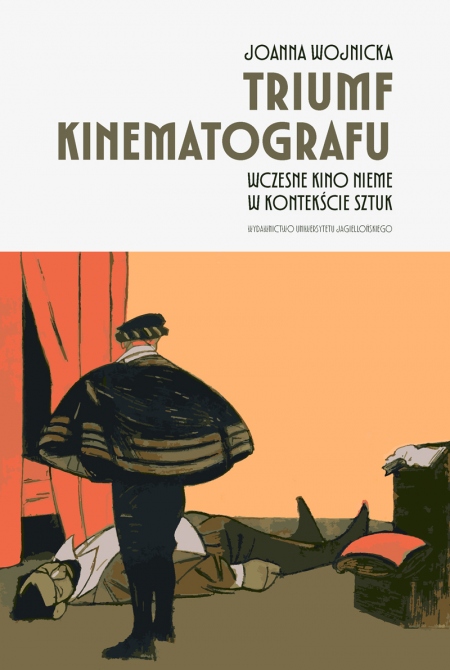
Triumf kinematografu
Wczesne kino nieme w kontekście sztuk
Pages: 292
Book format: 15,8 x23,5 cm
Publication date: 2026
Release date: 29.05.2026
Book description
This book examines European cinema (with a lesser focus on American cinema) of the second decade of the twentieth century, situating it within the broader context of its relationship to the traditional arts—most notably literature and theatre, but also dance and pantomime. The study is structured into four main parts. The first part explores the reflections on cinema formulated by the Italian-French writer Ricciotto Canudo. The second traces the emergence of the concept of artistic cinema, discusses the activities of the Film d’Art and SCAGL production companies, and analyzes the film work of the eminent theatre reformer André Antoine. The third part, entitled Within the Circle of Dance and Pantomime, investigates the relationship between silent cinema and these art forms, as well as the involvement of numerous artists with film, including Hugo von Hofmannsthal and Max Reinhardt. The final part is devoted to the cinematic interests of Expressionist writers, among them Max Brod, Kurt Pinthus, Walter Hasenclever, and Georg Kaiser. By incorporating their theoretical reflections and creative works, the book offers a modest expansion of the established concept of German film Expressionism in film historiography.
About Author
Joanna Wojnicka – a film historian and associate professor at the Institute of Audiovisual Arts of the Jagiellonian University. She specializes in the history of European cinema, as well as the relationships between film and other arts, particularly literature and theatre.
Language
Polish
Title in English
The triumph of cinema. Early silent cinema in the context of the arts
Edition
first
Authors
Joanna Wojnicka

ISBN: 978-83-233-5665-3
e-ISBN (pdf): 978-83-233-7803-7
Country of producer: Poland
RECOMMENDED BOOKS
65.00
zł
52.00
zł

NEW BOOKS













Choose chapters to buy:
Order value:
0.00 zł