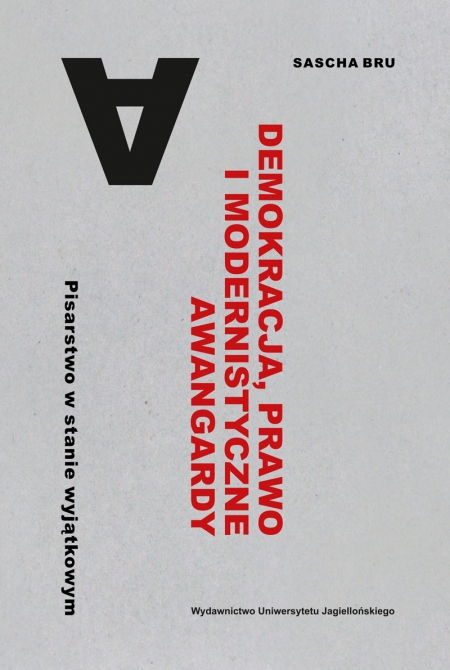
Demokracja, prawo i modernistyczne awangardy
Pisarstwo w stanie wyjątkowym
Translation: Iwona Boruszkowska, Kasper Pfeifer
Series: Awangarda / Rewizje
Pages: 296
Book format: 15,8 x23,5 cm
Publication date: 2026
Release date: 13.03.2026
Book description
Originally published by Edinburgh University Press, the book is a pioneering study of the relationship between the European avant-garde and democracy. Focusing on the continental avant-gardes of the 1910s and 1920s, Bru fundamentally revises the existing understanding of the cultural and political history of modernism. He analyzes the works of, among others, F.T. Marinetti, Richard Huelsenbeck, and Paul van Ostaijen, situating them within the exceptional democratic context of the First World War and the subsequent political upheavals.
The study demonstrates that in conditions of “states of exception,” when democratic institutions and the autonomy of art were suspended, avant-gardists devised a variety of strategies to safeguard the sovereignty of art—from transforming politics and law into genuine artistic material to creating alternative models of democracy. Contrary to the common assumption that anti-art gestures were meant to abolish art’s autonomy and assimilate it to politics, Bru shows that avant-gardists were, in fact, among the staunchest defenders of art’s independence in modern times.
The book establishes a dialogue between Anglo-American and European modernist studies, offers new interpretations of Berlin Dada, Futurism, and Expressionism, and proposes innovative historical frameworks for analyzing the continental avant-garde in a cultural-political perspective.
The study demonstrates that in conditions of “states of exception,” when democratic institutions and the autonomy of art were suspended, avant-gardists devised a variety of strategies to safeguard the sovereignty of art—from transforming politics and law into genuine artistic material to creating alternative models of democracy. Contrary to the common assumption that anti-art gestures were meant to abolish art’s autonomy and assimilate it to politics, Bru shows that avant-gardists were, in fact, among the staunchest defenders of art’s independence in modern times.
The book establishes a dialogue between Anglo-American and European modernist studies, offers new interpretations of Berlin Dada, Futurism, and Expressionism, and proposes innovative historical frameworks for analyzing the continental avant-garde in a cultural-political perspective.
About Author
Sascha Bru is a Belgian scholar of Russian and Romanian descent. He is a professor at the Arts Faculty of the University of Leuven – a stone's throw away from Brussels – where he teaches critical theory and comparative literature. For two decades now his research has focused mainly on manifestations of the avant-garde, that is on radically experimental and socially engaged practices across art forms and media.
Funding

This publication was financed by the Faculty of Polish Studies as part of the Excellence Initiative Strategic Program at the Jagiellonian University
Language
Polish
Original title
Democracy, Law and the Modernist Avant-Gardes: Writing in the State of Exception
Original language
English
Edition
first
Authors
Sascha Bru

Translation
Iwona Boruszkowska
, Kasper Pfeifer
ISBN: 978-83-233-5622-6
e-ISBN (pdf): 978-83-233-7770-2
Country of producer: Poland
RECOMMENDED BOOKS
NEW BOOKS



Podstawowe komponenty badań naukowych online w zarządzaniu
( Paperback with flaps )
51.45
zł
41.16
zł









Museum Queeries: Two-Spirit, Indigiqueer, and LGBTTQ* Interventions into Museums, Archives, and Curating
( Paperback with flaps )
61.95
zł
49.56
zł

Uwarunkowania ochrony dziedzictwa kulturowego – celuloidowego, prawnego, architektonicznego, muzealnego
( Paperback )
54.60
zł
43.68
zł


Choose chapters to buy:
Order value:
0.00 zł