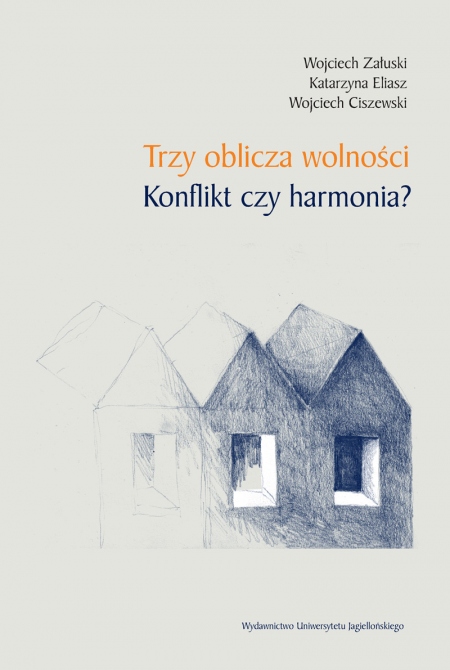
Trzy oblicza wolności
Konflikt czy harmonia?
Pages: 206
Book format: 15,8 x 23,5 cm
Publication date: 2025
Release date: 19.12.2025
E-book publication date: 19.12.2025
Book description
Our aim is to identify the most significant meanings of freedom—where the criterion of significance is, so to speak, their persistent presence in philosophical debates, which in turn stems from their existential relevance—without attempting to determine which of them is semantically fundamental. We will then proceed to a careful analysis of these meanings, including their relationship to law. We contend that there are three principal meanings of freedom: inner (positive) freedom, external (negative) freedom, and political freedom.
The first of these—inner freedom—differs from the other two in that it refers to the individual as such, rather than the socio-legal context in which the individual exists. A person who exercises self-mastery, who governs their passions and is the true author of their actions, may be said to possess inner freedom.
In contrast, external or negative freedom refers to freedom from coercion—it denotes the absence of obstacles posed by other individuals or institutions to the pursuit of one’s goals. It implies the lack of arbitrary interference in one’s actions.
The first of these—inner freedom—differs from the other two in that it refers to the individual as such, rather than the socio-legal context in which the individual exists. A person who exercises self-mastery, who governs their passions and is the true author of their actions, may be said to possess inner freedom.
In contrast, external or negative freedom refers to freedom from coercion—it denotes the absence of obstacles posed by other individuals or institutions to the pursuit of one’s goals. It implies the lack of arbitrary interference in one’s actions.

Language
Polish
Title in English
The Three Faces of Freedom. Discord or Harmony?
Edition
first
Authors
Wojciech Załuski
 , Katarzyna Eliasz
, Wojciech Ciszewski
, Katarzyna Eliasz
, Wojciech Ciszewski
, Katarzyna Eliasz
, Wojciech Ciszewski
Cover design
Paweł Sepielak
ISBN: 978-83-233-5610-3
e-ISBN (pdf): 978-83-233-7758-0
Country of producer: Poland
Open Access
All rights reserved. Open access permitted within the scope of fair use of protected works.
RECOMMENDED BOOKS

65.00
zł
52.00
zł
NEW BOOKS







Museum Queeries: Two-Spirit, Indigiqueer, and LGBTTQ* Interventions into Museums, Archives, and Curating
( Paperback with flaps )
61.95
zł
49.56
zł


Choose chapters to buy:
Order value:
0.00 zł