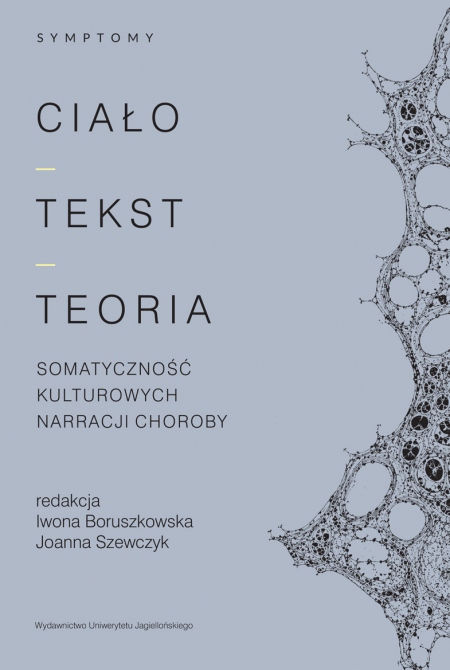
Ciało-tekst-teoria
Somatyczność kulturowych narracji choroby
Edited by: Iwona Boruszkowska, Joanna Szewczyk
Series: Symptomy
Pages: 398
Book format: 16 x 23,5 cm
Publication date: 2026
Book description
Body–Text–Theory: The Somaticity of Cultural Narratives of Illness inaugurates the scholarly series “Symptoms” (Jagiellonian University Press), developed by the Center for Research on Cultural Discourses of Illness. The volume approaches the “symptom” as a crossroads between soma and discourse—between lived experience and representation, medical practice and narrative techniques.
The book shifts the focus from what literature says about illness to how it makes illness experience visible and communicable. Its key axis is form–affect–ethics: how genre, rhythm, composition, and typography co-constitute pain, fear, shame, mourning, care—and even laughter.
Three concepts organize the volume: aesthetics of vulnerability, pathography (including “second-degree pathographies”: caregivers’ and witnesses’ accounts), and somatopoetics—a method and an ethics of close reading attentive to the body’s work in language and textual form.

Edited by
Iwona Boruszkowska
 , Joanna Szewczyk
ISBN: 978-83-233-5687-5
e-ISBN (pdf): 978-83-233-7820-4
Country of producer: Poland
RECOMMENDED BOOKS


65.00
zł
52.00
zł

NEW BOOKS




Museum Queeries: Two-Spirit, Indigiqueer, and LGBTTQ* Interventions into Museums, Archives, and Curating
( Paperback with flaps )
61.95
zł
49.56
zł


Sulṭān bin Muhammad Al-Qāsimī - w służbie nauki i kultury arabskiej
( Paperback with flaps )
57.75
zł
46.20
zł



Dzieje Czytelni Polskiej i Ośrodka Informacji i Kultury Polskiej w Budapeszcie (1951–1989)
( Paperback )
61.95
zł
49.56
zł


58.80
zł
47.04
zł
Ciało-tekst-teoria
Somatyczność kulturowych narracji choroby
Ciało-tekst-teoria
Somatyczność kulturowych narracji choroby
Choose chapters to buy:
Order value:
0.00 zł